
"The summer I was eight years old, five hours disappeared from my life. Five hours, lost, gone without a trace..."
- Brian Lackey
I'm not sure how to begin writing a Film Muse for Mysterious Skin. It's wintry, crude, passionate, powerful, and extremely honest. But in a way it is almost indescribable. If I would say anything I'd say that this film was really needed. To this day I still haven't seen a film that comes close to this subject matter. I don't think I would have treated movies the way I do now if I didn't experience this film.


Directed by Gregg Araki and adapted into a screenplay based on Scott Heim's 1996 novel of the same name, Mysterious Skin debuted in 2004. The film stars some of my favorite actors to this date: Brady Corbet, Joseph Gordon-Levitt, Michelle Trachtenberg, Elisabeth Shue, and Jeffrey Licon.
The story is about two boys who have to cross paths in order to find out the truth of what happened one night 10 years ago. Brian, a shy and perhaps emotionally stunted young man spends his evenings watching UFO shows much to his mother's dismay. He obsesses over this idea that we was abducted by aliens as a child, which would explain his blackout memories and strange nosebleeds. Neil on the other hand, a cold yet evocative teen, trades tricks for pleasures in the next town over. Brian determinedly sets out on a journey to find Neil who he remembers from his abduction dreams. As the viewer slides into the dismal ambience of the character's stories, it becomes clearer that this isn't a sci-fi film - but something much darker.


When I saw Mysterious Skin for the first time I felt like I was going to throw up. No gore or cheap tricks were used and maybe that was the most haunting factor of all. Instead, Araki chose to show the underbelly of suburban childhoods - the dysfunctional and presumably normal ones. He shows the missed moments that shape us all as human beings.
As disturbing as the film was I couldn't help but feel this mass amount of appreciation for it. It was like this huge catharsis washed over me the first time I saw it. There isn't any other film that I've connected with that truly speaks for those who's stories are forgotten and repressed. Mysterious Skin vocalizes these perspectives in such a delicate way. It touches on the moments as a child when you want to scream but feel too paralized to do so. It heightens the confusion, the yearning for others' attention as a child and how it translates into adulthood. The pure innocence of it all.


I had to revisit this film after I saw White Bird in A Blizzard (2014) directed by Gregg Araki in theaters. As some Curbside Fashion readers may already know, I wasn't a fan of the movie at all. Yet after much consideration I decided to go back and study Araki's movies to rediscover why I loved his work so much. I guess it was a coping technique or something. I thought maybe then I could see why I didn't connect with his newest film, to just have some piece of mind and to pay homage to those moments when I first fell in love with his work.
What I didn't realize was the similar soundtracks used in both films which instantly tied all of Araki's concepts together. Robin Guthrie (Cocteau Twins) and Harold Budd compile these short melancholic songs that are dismal yet slightly understanding. The heavy synth blends all of the emotions together, creating this ghost world of memories. The heavy bass lines ground the listener to each of its characters. It is unbelievably authentic and earnest.


The moody (for lack of a better word) soundtrack lays down the track for the emotional scenarios that ensue. Aside from the two main characters' plot lines, I couldn't help be attracted to their mothers' stories as well.
What is most disturbing for some is the lack of familial control. After all, it's parents' duty to protect their children from the monstrosities of the world and in particular we often see young mothers picking up the slack. Some single mothers like Brian's morph into cookie cutter types - donning teddybear sweaters and offering nighttime glasses of milk. Those mothers seem like they manage, but clearly there is a disconnect between Brian's mom and her son.
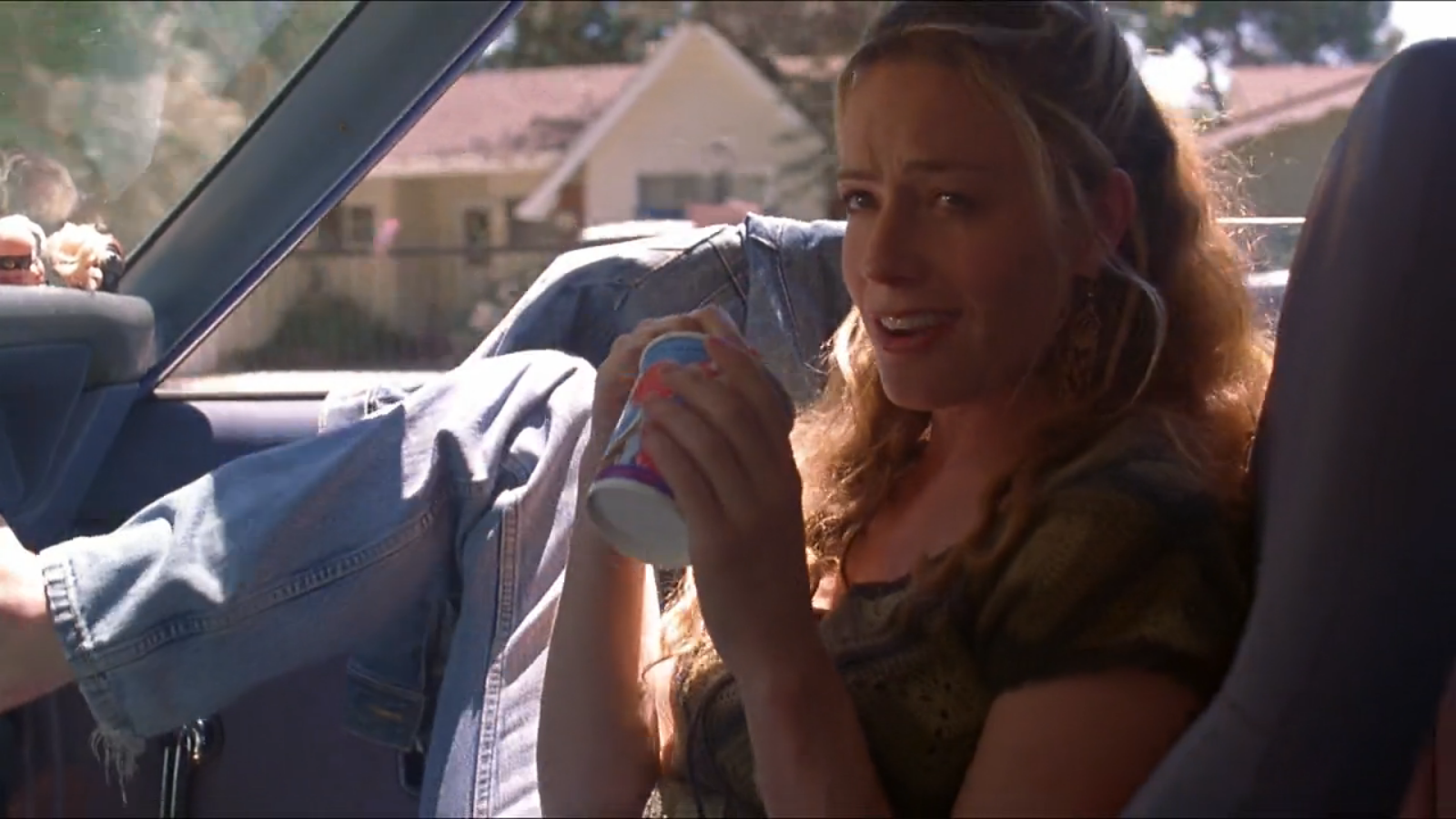
Other mothers can't deprive themselves like that, hoping that perhaps there is a silver lining to their circumstances. Neil's mother smothers him with kisses over Spaghetti-Os and gets Dairy Queen with his friends while he is away. She dances and sips on soda, wears red dresses. Although more seemingly unaware than Brian's mother, she is just as committed to loving her son as Brian's is.
What is most disturbing for some is the lack of familial control. After all, it's parents' duty to protect their children from the monstrosities of the world and in particular we often see young mothers picking up the slack. Some single mothers like Brian's morph into cookie cutter types - donning teddybear sweaters and offering nighttime glasses of milk. Those mothers seem like they manage, but clearly there is a disconnect between Brian's mom and her son.
Other mothers can't deprive themselves like that, hoping that perhaps there is a silver lining to their circumstances. Neil's mother smothers him with kisses over Spaghetti-Os and gets Dairy Queen with his friends while he is away. She dances and sips on soda, wears red dresses. Although more seemingly unaware than Brian's mother, she is just as committed to loving her son as Brian's is.
In an interview I saw a long time ago, Araki mentioned these two mothers and how we framed them. It's almost as if the idea of blaming the mothers for what happened to the two boys was completely out of the picture. Araki painted it like they were doing the best they could have done, so it seemed. There is no negative blame cast upon them, instead just pure trauma and pathos.


I really happened to like Michelle Trachtenburg's character Wendy, too. The way she looks out for her friends (and also herself) shows this grander understanding of relationships. She loves Neil so much yet knows that she can't do much about his behavior. It is almost painful watching their friendship and its borderline abuse. Wendy is the only character that leaves their town, but she doesn't leave the trauma. You can tell it will always stay with her. She is sort of an old soul in that way.


Gordon-Levitt's character is a conundrum. Like Araki's other films (Nowhere, The Doom Generation) his character is of the broody and brash sort. He is like this tornado, sucking in everyone around him without care or remorse. For most people this kind of protagonist would be off putting, but Gordon-Levitt doesn't portray him that way. His visual language shows apprehensiveness and iced over passiveness. We all end up like Wendy a little bit, loving him even though we know we shouldn't.
Gordon-Levitt's character is a conundrum. Like Araki's other films (Nowhere, The Doom Generation) his character is of the broody and brash sort. He is like this tornado, sucking in everyone around him without care or remorse. For most people this kind of protagonist would be off putting, but Gordon-Levitt doesn't portray him that way. His visual language shows apprehensiveness and iced over passiveness. We all end up like Wendy a little bit, loving him even though we know we shouldn't.


Brain played by Brady Corbet was by far the most heartbreaking character. Innocence was never lost, he never became hardened like Neil and Wendy. The way Corbet translated his character's curiosity and fears was almost tearful. Playing such a character with that amount of tact should never go without recognition.
When Brian finally makes a friend we see him really smile for the first time. His eyes light up, kind of like an 8-year old's in an 18 year old's body. We see him progress so much, which makes the ending even more shattering than anticipated. It isn't fair.


Araki did Mysterious Skin with this elegance that is lacking a lot in today's film. I read somewhere that he didn't want to scar the child actors with the roles that they were playing, so he took extra precaution with the way he went about the process. You can tell that every character in this film was 100% committed to their role which is extremely refreshing. Brady Corbet caught my eye in a weirdly transient way, something about the way he photographed on film really connected with me.


There isn't a solid negative critique I could wholeheartedly write about for Mysterious Skin. Any director who can talk about the traumas that unfolded in this film in such a tactful way deserves a lot of respect. Even if you disregarded the plot entirely, the editing pace and visual artistic direction was stunning. Each scene was curated to a specific artistic look in a non-obvious way. There wasn't any showing off or useless information to be absorbed. The characters all acted together harmoniously and the soundtrack still haunts me to this day. I do have to mention however that if you have not seen this film, be mindful of its triggers because there are a lot of them in this film. I hope you enjoy it as much as I did.
-Lauren Rose
Curbside Fashion


