Image Map
Showing posts with label gregg araki. Show all posts

6.11.14

Film Muse: Mysterious Skin

"The summer I was eight years old, five hours disappeared from my life. Five hours, lost, gone without a trace..."
- Brian Lackey

I'm not sure how to begin writing a Film Muse for Mysterious Skin. It's wintry, crude, passionate, powerful, and extremely honest. But in a way it is almost indescribable. If I would say anything I'd say that this film was really needed. To this day I still haven't seen a film that comes close to this subject matter.  I don't think I would have treated movies the way I do now if I didn't experience this film.


Directed by Gregg Araki and adapted into a screenplay based on Scott Heim's 1996 novel of the same name, Mysterious Skin debuted in 2004. The film stars some of my favorite actors to this date: Brady Corbet, Joseph Gordon-Levitt, Michelle Trachtenberg, Elisabeth Shue, and Jeffrey Licon. 

The story is about two boys who have to cross paths in order to find out the truth of what happened one night 10 years ago. Brian, a shy and perhaps emotionally stunted young man spends his evenings watching UFO shows much to his mother's dismay.  He obsesses over this idea that we was abducted by aliens as a child, which would explain his blackout memories and strange nosebleeds. Neil on the other hand, a cold yet evocative teen, trades tricks for pleasures in the next town over. Brian determinedly sets out on a journey to find Neil who he remembers from his abduction dreams. As the viewer slides into the dismal ambience of the character's stories, it becomes clearer that this isn't a sci-fi film - but something much darker. 


When I saw Mysterious Skin for the first time I felt like I was going to throw up. No gore or cheap tricks were used and maybe that was the most haunting factor of all. Instead, Araki chose to show the underbelly of suburban childhoods - the dysfunctional and presumably normal ones. He shows the missed moments that shape us all as human beings. 

 As disturbing as the film was I couldn't help but feel this mass amount of appreciation for it. It was like this huge catharsis washed over me the first time I saw it. There isn't any other film that I've connected with that truly speaks for those who's stories are forgotten and repressed. Mysterious Skin vocalizes these perspectives  in such a delicate way.  It touches on the moments as a child when you want to scream but feel too paralized to do so. It heightens the confusion, the yearning for others' attention as a child and how it translates into adulthood. The pure innocence of it all. 


 I had to revisit this film after I saw White Bird in A Blizzard (2014) directed by Gregg Araki in theaters. As some Curbside Fashion readers may already know, I wasn't a fan of the movie at all. Yet after much consideration I decided to go back and study Araki's movies to rediscover why I loved his work so much. I guess it was a coping technique or something. I thought maybe then I could see why I didn't connect with his newest film, to just have some piece of mind and to pay homage to those moments when I first fell in love with his work. 

What I didn't realize was the similar soundtracks used in both films which instantly tied all of Araki's concepts together. Robin Guthrie (Cocteau Twins) and Harold Budd compile these short melancholic songs that are dismal yet slightly understanding. The heavy synth blends all of the emotions together, creating this ghost world of memories. The heavy bass lines ground the listener to each of its characters. It is unbelievably authentic and earnest. 


The moody (for lack of a better word) soundtrack lays down the track for the emotional scenarios that ensue.  Aside from the two main characters' plot lines, I couldn't help be attracted to their mothers' stories as well.

What is most disturbing for some is the lack of familial control. After all, it's parents' duty to protect their children from the monstrosities of the world and in particular we often see young mothers picking up the slack. Some single mothers like Brian's morph into cookie cutter types - donning teddybear sweaters and offering nighttime glasses of milk. Those mothers seem like they manage, but clearly there is a disconnect between Brian's mom and her son.

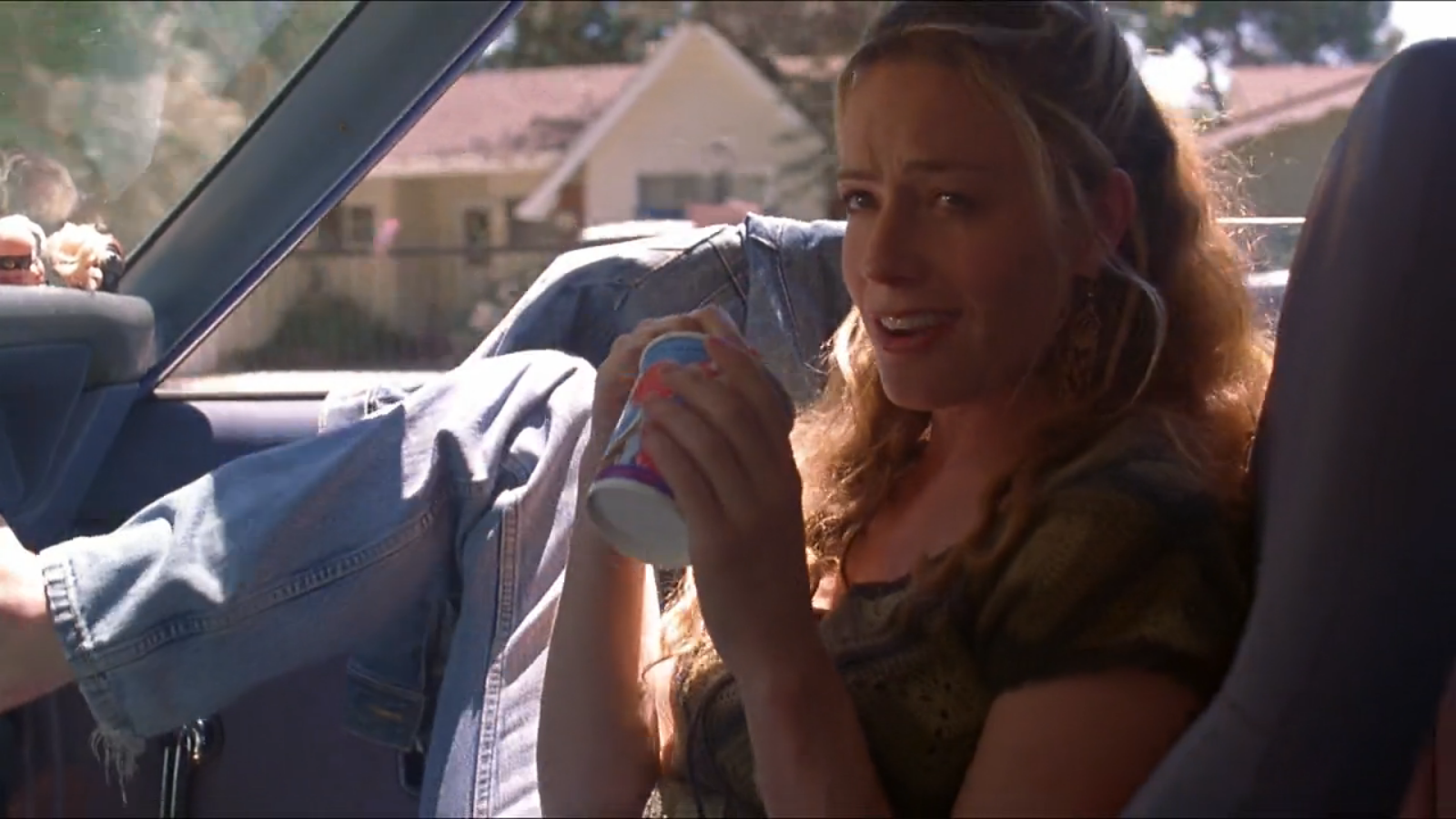
Other mothers can't deprive themselves like that, hoping that perhaps there is a silver lining to their circumstances. Neil's mother smothers him with kisses over Spaghetti-Os and gets Dairy Queen with his friends while he is away. She dances and sips on soda, wears red dresses. Although more seemingly unaware than Brian's mother, she is just as committed to loving her son as Brian's is. 

In an interview I saw a long time ago, Araki mentioned these two mothers and how we framed them. It's almost as if the idea of blaming the mothers for what happened to the two boys was completely out of the picture. Araki painted it like they were doing the best they could have done, so it seemed. There is no negative blame cast upon them, instead just pure trauma and pathos. 


I really happened to like Michelle Trachtenburg's character Wendy, too. The way she looks out for her friends (and also herself) shows this grander understanding of relationships.  She loves Neil so much yet knows that she can't do much about his behavior. It is almost painful watching their friendship and its borderline abuse. Wendy is the only character that leaves their town, but she doesn't leave the trauma. You can tell it will always stay with her. She is sort of an old soul in that way.


Gordon-Levitt's character is a conundrum. Like Araki's other films (Nowhere, The Doom Generation) his character is of the broody and brash sort. He is like this tornado, sucking in everyone around him without care or remorse. For most people this kind of protagonist would be off putting, but Gordon-Levitt doesn't portray him that way. His visual language shows apprehensiveness and iced over passiveness. We all end up like Wendy a little bit, loving him even though we know we shouldn't.


Brain played by Brady Corbet was by far the most heartbreaking character. Innocence was never lost, he never became hardened like Neil and Wendy. The way Corbet translated his character's curiosity and fears was almost tearful. Playing such a character with that amount of tact should never go without recognition. 

When Brian finally makes a friend we see him really smile for the first time. His eyes light up, kind of like an 8-year old's in an 18 year old's body. We see him progress so much, which makes the ending even more shattering than anticipated. It isn't fair.


Araki did Mysterious Skin with this elegance that is lacking a lot in today's film. I read somewhere that he didn't want to scar the child actors with the roles that they were playing, so he took extra precaution with the way he went about the process. You can tell that every character in this film was 100% committed to their role which is extremely refreshing. Brady Corbet caught my eye in a weirdly transient way, something about the way he photographed on film really connected with me.  


There isn't a solid negative critique I could wholeheartedly write about for Mysterious Skin. Any director who can talk about the traumas that unfolded in this film in such a tactful way deserves a lot of respect. Even if you disregarded the plot entirely, the editing pace and visual artistic direction was stunning. Each scene was curated to a specific artistic look in a non-obvious way. There wasn't any showing off or useless information to be absorbed. The characters all acted together harmoniously and the soundtrack still haunts me to this day. I do have to mention however that if you have not seen this film, be mindful of its triggers because there are a lot of them in this film. I hope you enjoy it as much as I did.

-Lauren Rose 
Curbside Fashion

11.10.14

You Don't Know Anything (Come In The Right Way)

If there is one thing that I've learned this month - it is that I do not know anything. 

And you probably don't know anything either.

For some, that last line could have stung a little.  No one ever wants to hear about how much they don't know about something. After all, you've been in school for how many years now? It's embarrassing, daunting, and frustrating. That is, if you let it be. 


I admit these posts have been pretty infrequent ever since I announced my tentative departure from Youtube. As a third year in college, my ass has been grass (to put it eloquently). I could write an entire essay about how tough juggling class, work, volunteering, and relationships are. But I won't. This whole thing is starting to sound a bit too flowery anyways.

What I'm getting at is that I've been happy. I've been happy about not knowing anything. I welcome not knowing anything. Still don't know what I'm talking about? Let's phone a friend then. 

(stills from My So-Called Life created by Winnie Holzman) 

Enter: Angela Chase with her newly dyed "Crimson Glow" hair. For those who are unfamiliar, My So-Called Life starring Claire Danes was this super meta teenage show that lasted from 1994-1995 for one (amazing) season. The story is about Angela Chase, a young girl just coming of age,  dealing with friends, crushes, and all that is high school. What is extremely bizarre about the show is the narration by Angela, an open diary format if you will. Angela intricately questions the disparity between adults and teens, the complexity of relationships, and her frustrations of not knowing the answers. It is simply honest (and a little odd at first).

Cut to: me, sitting on my tweed apartment couch having my (first) mental breakdown of the semester. At that point in time, the days were beginning to blur as I constantly was working on some kind of class assignment (I was also paranoid that I was possibly getting mono?). After much internal debate, I decided to partake in one of those "self care" mantras and call in sick to my job. 

 I walked to Noodle's and Company and bought myself a healthy (healthy as it robust - not the size of my palm)  takeout size of their Wisconsin Mac & Cheese with grilled chicken atop. With my mac & cheese in hand, I went back to my apartment, pulled out the plastic fork, and re-watched the first episode of My So-Called Life

Watching My So-Called Life in college made me feel human again. I first binge-watched the show junior year of high school, thanks to my friend Layla who owned the box season. We laughed, we teared up, and then it was over in a flash.  I never revisited the show again until I saw people mentioning it online.  Why was it so compelling? Because I'm still asking those same questions that Angela asked, although now I'm just taken more seriously due to my age. I formed this holy bond with the T.V. show, blessing the creators for bringing it into our world.

(stills from Blue Valentine (2010) dir. Derek Cianfrance)

Then there was Derek Cianfrance - one of my favorite directors. I recently re-watched Blue Valentine (2010) and fell in love with story telling once again. Blue Valentine is a romantic tragedy, I'd say. It's the most honest movie about relationships and how they can fall apart. I don't know what really got me, the Grizzly Bear soundtrack, the cinematography, or the acting by Michelle Williams and Ryan Gosling. 

As someone who enjoys film excessively, sometimes it can be hard to watch something without trying to critique it. After all, how can we tell what's good in a movie unless we categorize and rank it?

 Look for continuity errors! Did they fumble on that line? How about that 180 degree rule, huh?  Oh man, look at that plot structure! 

Especially if you are someone who tries to make films yourself, watching others' work can be a lofty process. Maybe you're bitter because you'll never have the budget they had to make the film. Or maybe you'd feel sad because you feel like you could never make something as good as what you were seeing. Maybe you'll never even get to do what they did. Maybe you'll never make it.

As I watched Blue Valentine on my burning hot laptop, all of those questions faded into the background as I truly just enjoyed the film. Instead of looking for all of the answers, I let myself be still and connect with the characters. I guess that is when you know you really love something. 

(still from White Bird in a Blizzard (2014) dir. Gregg Araki)

So here I am with my hippie-talk: enjoy everything, man! *lights fifth joint*

But wait, didn't I just totally smack talk (twitter plug) Gregg Araki's new film White Bird in a Blizzard?  I've been thinking about this film a lot recently. Regular Curbside Fashion readers know that Gregg Araki is one of my other favorite directors (Doom Generation, Mysterious Skin) and I was anticipating his new film for months. The film was visually beautiful full of shag carpets and piercing blue Eva Green (The Dreamers) eyes, but I simply could not connect with the main actress' performance. 

I was devastated in purely selfish kind of way. I expecting to be fully catered by an artist, a.k.a. a real person. When I disagreed with the choices Araki made, it felt entirely too personal, as if he wronged me or something and I don't think that is good. I realized that the characters were meant to be brash (like all of Araki's other films), but I wouldn't allow it. And please do not get me wrong - you are allowed to dislike movies and critique things. But as I internally complained about how my favorite director let me down, something took over: Sea, Swallow Me by Cocteau Twins & Harold Budd.  

I started to catch myself listening to that song over and over, as it was featured as one of the main tracks in the movie. I began to think back to certain performances (Meloni, Green, Bassett) and now have a stronger appreciation for the film. Even some scenes by Woodley, whom I originally detested, I found to be extremely compelling. My perspective changed and I began to enjoy the film again. Of course there were things that I didn't like, but it wasn't a complete failure like I painted it as originally. 

I started to come in the right way. 


It was Grace Lee Boggs who introduced the ideology "come in the right way" in her book The Next American Revolution. Grace Lee Boggs is a feminist, social activist, and author who primarily focuses her efforts in Detroit, Michigan. In her book, she mentions how important it is to come into situations humbly and respecting others' experiences in order to create real change. Although this could certainly be applied to activism (as it should), it can be applied to almost everything else.

As I see it, coming in the right way is essential for people who are passionate yet discouraged. And being discouraged doesn't always mean seeming fearful of something, discouraged people come in a lot of different shapes and sizes. People who are discouraged can be jealous, bitter, fearful, cowardly, insecure, or negative. They can stop their dreams before they even try to make them happen. 

In this case, coming in the right way means letting yourself have a mental day off and not beating yourself up about it. Coming in the right way means wholeheartedly enjoying your favorite movies and drawing inspiration from them. Coming in the right way means allowing yourself to understand things before you criticize them.


Coming in the right way also means allowing yourself to try out new things. All of the photos above are prints that I took, the long exposure ones in collaboration with my photography friend Zack. For years I had always wanted to take these kind of night photos but never did. I was afraid that it was unsafe for me to go out alone since I was a woman, I was a afraid that the prints would turn out terribly and I'd waste my money, and I was ultimately afraid that I didn't have any talent. 

But I came in the right way and saw the experience as a learning opportunity.  The thrill of going out alone at night and capturing the sodium vapor lights that I always talk about was exhilarating. The act of collaborating with another artist was effortless. And the realization that I do have talent was actually very humbling. 

I guess what I'm trying to get at is to tell yourself that you don't know anything so that you can start from scratch all over again. It's terrifying, I know, but after you get over yourself you'll realize that you have the rest of your life to gain that "insider" status that you want. Stop trying to prove to others that you have something to say if you already know that you do.

Go watch a good movie and come back an entirely different person.

Lauren Rose
Curbside Fashion 


14.7.14

Film Muse: IRL (2013)

Hey Film Muse-ers, 

Recently I've been thinking a lot about this blog: what it has become and what it will be. To be honest, I never intended Curbside Fashion to be a blog of almost solely film reviews - yet here we are. I started to question why I liked doing these posts and I realized that it's because I really enjoy other people's visions and success. When the music lines up perfectly and the shot is awe-inspiring I can't help but document it and share it with others. Ever since I was a kid I was mesmerized of how film can generate undeniable empathy within its viewers. All it takes is one good film to see the world differently.

I've learned from my experience as a Fashion Blogger that the field is very individualistic. Your dress size, hair color, and trendy accessories are all compared to the mass consumer market and sometimes the beauty of fashion gets lost. It is hard to explain. Yet I truly believe that watching films can inspire many facets of your life, including fashion. Even flawed films are worth seeing and talking about if they inspire you in other ways, and I believe it is important to support those who put their ideas into the world and don't get enough credit for doing so.

 Today I'm bringing you a short film from Grant Singer called IRL (2013).

   
IRL is a twenty minute long short film starring Sky Ferreira as Angel, a girl who is trying to remember her previous trip-induced NYC night out with a mysterious woman. As Angel tries to piece together the evening, she learns of a murder that took place on the "L" train tracks that she may or may not have been linked to. IRL's characters are hyper stylized, reminiscent of Gregg Araki's '90s teenage crews (Totally Fucked Up, The Doom Generation, Nowhere) - this group peppered with 2013 texting lingo. The underground club scenes are breathtaking, as they would be - given that Grant Singer has done so many great music videos in the past (Night Time My Time, You're Not The One). What I particularly enjoyed about Singer's direction is his curated aesthetic to create a mystery urban world of sterile apartments and neon smoke infused raves. It is clear that Singer's strong suit lies within musical montages that evoke unspoken emotions.


Originally written by Patrick Sandberg, I was very intrigued of the IRL script. As previously mentioned, the artistic head nod to Gregg Araki was crystal clear in terms of the character's dialogue. Araki's characters often spit some kind of razor sharp banter among each other. Araki's films have been ripped apart by critics, mainly for this reason. It isn't always easy to like such blunt (and sometimes vapid) characters. IRL dangerously goes further. Angel's friends obsessively snark at their iPhone screens, creating an insipid cloud of meaningless modern friendships. Although it was clear that Sandberg wanted to show the emptiness of these characters, something did not sit right with me.  In fact, I cringed a bit while watching these scenes. Not only is it hard to digest representations of internet subcultures on screen, but I'd imagine that it's even harder to act out the dialogue in a likeable way itself. Some non-actors fumbled with this delivery, yet where IRL lacked in acting it made up for itself in visuals. Watching IRL is a good study in understanding the importance of acting, especially in stylistic settings.


The reason I'm probably the most partial to IRL is because of the cinematographer Jason McCormick's work. The compositions of nearly every shot are so beautiful. The day scenes are washed out in the best way possible, while the night scenes seem to be pulsing with glowing energy. In particular, the warped shots of Angel in the convenience store are some of the most visually interesting frames I've seen recently. 


Sky's performance is one of the best. Her expressions are hauntingly meant for this film, and her voice carries the story along. These past few years I've kept a tab on Ferreira, especially when she collaborated with Gaspar Noé (Enter The Void) for her Night Time, My Time album cover. Sky has some great tastes, not only in pop culture - but in collaborators as well. She is one of those artists to keep an eye on. 


The stand out characters of IRL were actually Damien Echols and Genesis P-Orridge. They both looked like they stepped out of a Harmony Korine/Gregg Araki movie. It is so clear that they had the vibe that Singer was going for, and they delivered their lines perfectly. They were intensely eerie and somewhat comical - heightening the potency of the film's suspense. 


For music fans out there, Salem's John Holland and Gatekeeper's Aaron David Ross among others contributed to IRL as well. Their grainy slow pitched sounds permeate the plot line, so make sure you have a good speaker system or pop in those headphones when you watch the film. 


Overall, IRL is one of those films that you should study. While some of the acting is crude, by no means should the film be dismissed. You can learn from films' mistakes while still appreciating the effort, and that is why I make Film Muse posts. I respect this film enough to share it with you all because I see the potential and the seams of the idea. If you are an artist, you should be familiar with these refinement gaps already, and I believe it's important to support those who are still mastering the craft. Regardless, IRL was an enjoyable short film and I will be keeping tabs on all of the film's collaborators. I hope you all enjoy it as much as I do.

-Lauren Rose
Curbside Fashion